Showing posts with label agile product owner certification in Bangalore. Show all posts

Thursday, September 23, 2021

How to pass Professional Scrum Product Owner (PSPO I) Certification

Professional Scrum Product Owner (PSPO) is a series of certifications from www.scrum.org for Product Owners. It contains 3 levels of assessment: PSPO I, PSPO II, and PSPO III. Depending on the level of understanding and knowledge of Product ownership ranging from beginner to distinguished, people can select the assessment level. The assessment covers the knowledge, understanding and the ability to apply the learning in practical experiences. In the product ownership journey, one can advance from the 1st level to the level of mastery by gaining ground-level experience and appearing for the final assessment (PSPO III).


PSPO I

The first level, Professional Scrum Product Owner I (PSPO I), tests the fundamental know-how, about the Scrum framework and optimal value creation and delivery, of the product owners. Beginners in the role can use agile product owner certification in Bangalore assessment to help validate their knowledge. This assessment can be taken from the scrum.org website by paying the necessary exam fees, which currently is USD 200 for 1 attempt. People wishing to appear for the assessment need not take any course, although attending the class is highly recommended.

PSPO I Assessment

The assessment consists of 80 questions, and the timebox for the exam is an hour (60 minutes). It has multiple choice, multi-answer, and True or False questions. Currently available in English only, the passing score is high at 85%, which means that applicants should get at least 68 correct out of 80. The assessment is not a proctored one. It can be taken from the comfort of your home or any place where there is minimal disturbance.

Once you pass the assessment, you will receive an industry-recognized certification. This certification does not expire and does not warrant any renewal payments. The focus areas of this assessment are as below:

Understanding and Applying the Scrum Framework:

* Empiricism, Scrum Team, Events, Artifacts, Done.

Developing People and Teams:

* Self-Managing Teams.

Managing Products with Agility:

* Forecasting & Release Planning, Product Vision, Product Value, Product Backlog Management, Business Strategy, Stakeholders & Customers.

Alright, let’s get to the part of discussing the preparation aspects. In my view, there are essentially 3 parts to it:

Learn

Build a strong fundamental knowledge of the Scrum framework and product ownership. This can be obtained by appearing for classes from any of the Professional Training Network (PTN) partners. As I have mentioned earlier, this is not mandatory to appear for the assessment. However, it is very useful in understanding the nuances of product ownership and sets a solid foundation to grow on.

Study

·       Read the latest and official Scrum guide from here.

·       Review the EBM guide and the Nexus framework.

·       Learn more about the subject areas as outlined above.

·       The Professional Scrum Product Owner book by Don McGreal and Ralph Jocham is another good resource.

·       Product Goal – A Commitment

·       Read blogs from authentic Professional Scrum Trainers

Practice

The Open assessments provided on the scrum.org website are a great start. These are free and can help with gaining confidence initially. Continue practicing with them until you get a 100% score continuously at least 3 times. Discuss with like-minded people on various forums, and validate your thoughts. Gain knowledge by applying the principles and learning in the workplace. Keep looking for opportunities to improve.

When appearing for the assessment, ensure that your time is free from distractions. Stay hydrated as necessary and remember that you will lose time if you have to take pee breaks. Be confident in the learning that you have gained. Pay attention, and interpret the questions correctly as they might not be straight from the book (Scrum guide). If you are not so sure of the answer to a question or two, flag them and move on with the rest. You can come back to them at the end or when the time permits. Inspect and adapt!

Resource: https://www.tryscrum.com/blogs/how-to-pass-professional-scrum-product-owner-i-pspo-i-certification/

Tuesday, July 20, 2021

What is Manager’s role in Scrum?

There is one frequent question that I encounter in my workshops. There is a piece of information that is missing in the Scrum Guide. Interestingly, It is regarding the managers. Where is the role of Manager in Scrum? The missed-out information makes many organisations confused if they have a similar place and adopts Scrum or present an Agile transformation.

While there are apparent intermediate paths present for the managers and other senior leadership position holders, the unclearly defined middle managers often question the roles in official Scrum they fill. What are they? Are they product owners? Or a scrum master? Or developers?

It can be a challenging leadership problem and problematic to resolve. However, there is no direct and clear answer to the query. For clearing the dilemma, I have to recall the elementary difference between a project and a product.


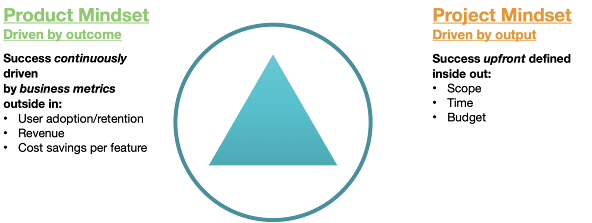
Project Vs Product

As you can notice, agile product owner certification in Bangalore focuses directly on products; thus, you have a Product owner. In traditional project management, the success of the project gets measured against scope, time and cost. Thus, the process leads to lesser value management and focuses on task management.

In contrast, the product mindset gets derived from the outcome, and the project mindset is activity. In traditional management, all three variables get managed by the project manager.

In a product environment, all the variables receive collaborative management.

For example, the scope and time get handled by the Scrum team, while the cost is by the product owner. In such cases, the confusion lies in the manager’s role.

Role Mapping

Direct one-to-one mapping is the way out for most of the executives of the organisations. We are following the Agile transformation. Thus, all these people will get a role in Scrum, and the rest of the group will get another position in Scrum. Among all these, I encounter a common idealogy in one-to-one mapping: taking the project management office and turning them into scrum masters and taking the business analysts to enrol them in product ownership roles. But, as per my point of view, it is not a great solution.

Is there a superior approach?

A “try scrum” entity identifies how to determine and focus on the individual strengths of each employee. It is very crucial while undergoing an Agile transformation. If you know who will fit best for each of the roles, acquiring success gets easier. Also, considering the individual’s passion helps in redefining the new responsibilities.

Now, let me get back to the original doubt.

Where is the role of Managers in Scrum? Do we need them?

There is no direct answer to this. My answer to this question will be; it depends on the organisation. Considering my experience, managers can play enablers. Although there is no buzz about Management in Scrum, managemental aspects are present in Scrum.

According to the Scrum Guide, Scrum looks after the existing effectiveness of the management, environment, and functioning ability to improve them. In other words, it challenges the way that the Organisation works to create value.

Scrum is not a methodology. It deliberates gives the choice-making to the management. It allows the business to get structured rightly and organise itself to get better. Considering from my viewpoint, managers are certainly enablers and can perform varied responsibilities.

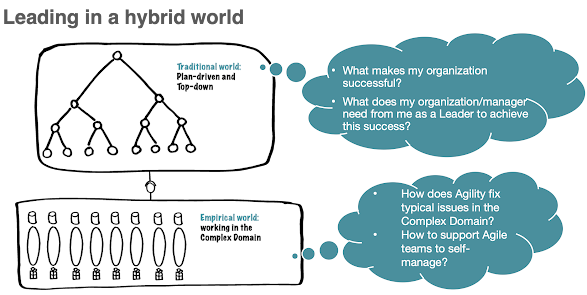
Leading in a Hybrid World

Every middle manager may not be suitable for the role of product owner or scrum master role. It leaves the scopes of uncertainties. But you need not worry. Despite having no role as a Scrum manager, it does not imply requiring them. Instead, it signifies that their role and responsibilities vary.


We primarily work in an environment that got created on traditional, plan-driven, and top-down principles. We are gradually transforming towards a self-organised and empirical environment. It gets designed for the complex domain. Leading an Agile team refers to making the people more successful with dynamicity. It is one of the major responsibilities of a manager. Among the many responsibilities of a manager, the following are a few significant ones:

·       Developing an environment for the growth of the Agile team

·       Work towards and organisation and scrum teams as a serving leader

·       Reconstruct the obstacles that hamper the growth

·       Proactively work on continuous improvement, self-improvement, feedback, adaptability.

·       Helping the team to succeed.

Conclusion

To conclude, Scrum does not have a role of a “manager”. It certainly does not imply we do not necessitate one. Ultimately, capitalising on individual strengths for transforming them to accomplish the new roles helps the organisation and individuals equally and leads to success.

Resource: https://www.tryscrum.com/blogs/what-is-managers-role-in-scrum/

Monday, April 12, 2021

Product Goal Is A Commitment! Learn By Agile Product Owner Certification in Bangalore

There have been a few changes in Scrum Guide 2020, and I am really excited. These changes focus on ‘Values’ within the framework of Scrum. Commitment, among all kinds of values, builds trust. Since the beginning days of my SCRUM workshops, I have been bombarded with questions, asking about commitment definition and perspectives.

I have a simple view. The entire Scrum team, with all its members, commits to embodying Scrum values. After the recent updates of Scrum Guide 2020, three distinct commitments have been attached to the artefacts. Commitment renders additional to quality to a specific artefact. It improves transparency, a significant pillar of empiricism. When there is a Product Backlog in an agile product owner certification in Bangalore, you can say that the Product Goal is the commitment.

Meaning of Product Goal

From my perspective, the product goal achieves the vision of the product, alongside meeting business objectives. Great goals must have an association with a comprehensive business strategy or a broader product. The product goal should be interpretable and actionable. It should also be achievable and easily measurable. The context of the relevant Product Backlog is rendered by Product Goal. You would know the reason why you are doing a specific activity. The Product Goal also adds more value to the customers and tells the stakeholders about its uniqueness. 

Scrum Guide is empty in a beautiful way. It never says about the Product Goal details. This allows the SCRUM team in forming the pertinently contextual goal.

Product Goal – for example

Goal: Tripling the revenue year-on-year

Metric: +$20 million revenue

Goal: High-grade Training Company

Metric: Rated as #1 on the platform of TrustPilot with a minimum of 10,000 reviews

Goal: The biggest e-commerce player

Metric: More than 1000 partners

Product Goal –illustration


Some of you might say it a broad vision, while others might term it as a goal. When you determine the Product Goal, context is practically everything.

Characteristics of Product Goal from the perspective of a SCRUM team:

Product Goal can be evolutionary alongside the Product.

It is a commitment pertaining to the Product Backlog. Product Owners get the required flexibility to operate when the particular Product gets somewhat rough. In other words, the Product goal is in the Product Backlog.

You can achieve a Product goal in either a few Sprints or numerous Sprints.

Typically Goals in Several Sprints may contribute to the Single Goal of the Product.

Product Goal creates and establishes transparency that tells about the objective of building the Product.

Sprint Review does not merely inspect specific increment, but it also monitors the progress in achieving the Product Goal.

Let us go through the Scrum Events and their relations to Product Goals.

Additional Inspection plus Adaptation Opportunities

In Craft, the strategic actions are designed by Product Goals. The structure assists you to organise and insightfully assemble the relevant strategic objectives in various containers. They can become useful guidelines for your roadmap. It would also constantly remind the team and the stakeholders about your progress.

Resource: https://tryscrum.com/2021/01/14/product-goal-is-a-commitment/