Showing posts with label scrum certification online. Show all posts

Wednesday, September 29, 2021

How to pass Professional Scrum Master I(PSM I)Certification

One of the most sought certifications in the Agile industry for Scrum Masters is Professional Scrum Master I (PSM I). The certification is offered by Scrum.org — The Home of Scrum. A foundational certification in the field of Scrum Mastery.


There are three levels of Professional Scrum Master Certifications Scrum.org offers. The other two are Advanced (PSM-II) and Distinguished (PSM-III) level certifications. There is no definitive order that you have to go. One can directly appear for PSM-III if they have a deep understanding of Scrum.

As the name suggests, “Professional” — One must exhibit a high standard of understanding in Scrum to gain this certification. PSM I demand an understanding of Scrum, as mentioned in the PSM training online Guide and it tests the consistency in using Scrum.

In this blog, I am going to cover the

·       Ways to get Professional Scrum Master Certified

·       Assessment areas

·       Learning references

·       Tips to crack the exam

Ways to get Professional Scrum Master I (PSM I) Certified

Scrum org offers two paths to PSM I Certification — Training with exam & Exam (Direct).

Training

Training for PSM I are offered

·       By Professional Scrum Trainers accredited by Scrum dot org after a rigorous assessment of depth in Scrum knowledge and Scrum Mastery experience.

·       By Professional Training Networks (PTN) — Recognised training partners of Scrum dot org in collaboration with Professional Scrum Trainers.

As part of the training, a candidate gets two attempts at PSM I exam.

Note: Beware of the bait that few people in the industry claim to take Scrum workshops to help get PSM. Go with Authenticity.

Direct Exam

One can directly buy a password from the Scrum dot org store by paying $150. The password is valid for only one attempt.

PSM I Assessment Areas

The foundational level, Professional Scrum Master (PSM I), assess a candidate’s basic understanding of the below areas.

Scrum Framework Understanding & its Application

·       Empiricism

·       Scrum Values

·       Scrum Team

·       Events

·       Artifacts

·       Done

Enabling Teams

·       Self-managed teams

·       Facilitation

·       Coaching & Mentoring

Agility in Product using Scrum

·       Product Value

·       Product Backlog Management

·       Stakeholders & Customers

·       Forecasting & Release Planning

Learning References

In my humble opinion, attending a Professional Scrum Master Workshop gives one well-rounded knowledge in all the above areas.

Apart from the class, use the below references.

·       Reading & the Scrum Guide is of utmost importance. Do not stop just by reading it. Use your learning preference to annotate it or digest it.

·       Finish the learning path for Scrum Master in the Scrum dot org

·       Reading references in Scrum dot org

·       Scrum Framework Foundational videos

·       Scrum Myths busted

·       True Leader

·       Whitepaper — Scrum Master Stages

·       Forever Scrum Master

·       Scrum Master & Product Owner — Same Person?

·       Product Goal — A commitment

·       A-Z with Scrum

Tips to crack the exam

Let us start with the Assessment,

·       The assessment is of 80 Multiple Choices questions. And the time limit is 60 minutes. One has to get 68 questions right to achieve the pass percentage, 85%.

·       Bookmark questions to revisit. One may run out of time if more time is spent on a single question.

·       Utilise the Scrum Open Assessment to get yourself confident with the format of the main exam. The open assessments are free. Take it as many times as possible to get familiarised. The open assessments provide feedback for every question at the end.

·       Take the assessment in a calm place where one can have the utmost focus.

·       Be sure to have a good internet connection as well. Do not close the browser at any cost; the attempt will be lost.

·       For technical glitches, reach out to Scrum dot org support.

Learning Tips

·       Practice the usage of Scrum terminologies as in Scrum Guide. Maybe through forming peer groups or self-recordings to reflect. Like, Daily Standup →Daily Scrum; Backlog Grooming → Product Backlog Refinement.

·       Scrum demands Empiricism, Self-management and Product thinking. Understand the why’s behind Scrum carefully and be mindful to choose answers adhering to it.

·       Watch out for universal statements in the exam. It may trap you to choose the wrong answer. Learn to differentiate the mandatory and non-mandatory elements in Scrum.

·       If you are unsure of the answers, try to avoid bad answers to nail the correct answer.

·       Move away from the traditional phase gated approaches. Learn to differentiate Scrum from traditional thinking and practices.

·       The Exam demands the information by the books. Go by the books and authentic information. Try not to bring one’s experience with Scrum, as in practice, one may not follow Scrum by the books.

Special Note: Do not refer to any mock-ups or practice tests as those are not endorsed by Scrum dot org and may not be authentic.

Resource: https://www.tryscrum.com/blogs/how-to-pass-professional-scrum-master-i-psm-i-certification/

Tuesday, July 20, 2021

What is Manager’s role in Scrum?

There is one frequent question that I encounter in my workshops. There is a piece of information that is missing in the Scrum Guide. Interestingly, It is regarding the managers. Where is the role of Manager in Scrum? The missed-out information makes many organisations confused if they have a similar place and adopts Scrum or present an Agile transformation.

While there are apparent intermediate paths present for the managers and other senior leadership position holders, the unclearly defined middle managers often question the roles in official Scrum they fill. What are they? Are they product owners? Or a scrum master? Or developers?

It can be a challenging leadership problem and problematic to resolve. However, there is no direct and clear answer to the query. For clearing the dilemma, I have to recall the elementary difference between a project and a product.


Project Vs Product

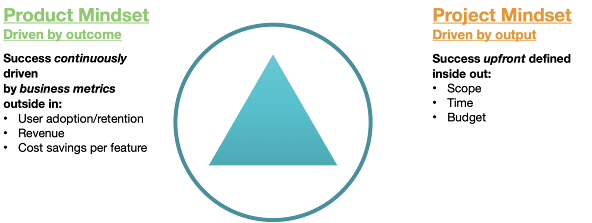
As you can notice, agile product owner certification in Bangalore focuses directly on products; thus, you have a Product owner. In traditional project management, the success of the project gets measured against scope, time and cost. Thus, the process leads to lesser value management and focuses on task management.

In contrast, the product mindset gets derived from the outcome, and the project mindset is activity. In traditional management, all three variables get managed by the project manager.

In a product environment, all the variables receive collaborative management.

For example, the scope and time get handled by the Scrum team, while the cost is by the product owner. In such cases, the confusion lies in the manager’s role.

Role Mapping

Direct one-to-one mapping is the way out for most of the executives of the organisations. We are following the Agile transformation. Thus, all these people will get a role in Scrum, and the rest of the group will get another position in Scrum. Among all these, I encounter a common idealogy in one-to-one mapping: taking the project management office and turning them into scrum masters and taking the business analysts to enrol them in product ownership roles. But, as per my point of view, it is not a great solution.

Is there a superior approach?

A “try scrum” entity identifies how to determine and focus on the individual strengths of each employee. It is very crucial while undergoing an Agile transformation. If you know who will fit best for each of the roles, acquiring success gets easier. Also, considering the individual’s passion helps in redefining the new responsibilities.

Now, let me get back to the original doubt.

Where is the role of Managers in Scrum? Do we need them?

There is no direct answer to this. My answer to this question will be; it depends on the organisation. Considering my experience, managers can play enablers. Although there is no buzz about Management in Scrum, managemental aspects are present in Scrum.

According to the Scrum Guide, Scrum looks after the existing effectiveness of the management, environment, and functioning ability to improve them. In other words, it challenges the way that the Organisation works to create value.

Scrum is not a methodology. It deliberates gives the choice-making to the management. It allows the business to get structured rightly and organise itself to get better. Considering from my viewpoint, managers are certainly enablers and can perform varied responsibilities.

Leading in a Hybrid World

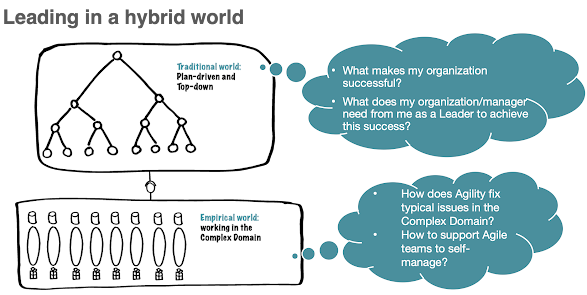
Every middle manager may not be suitable for the role of product owner or scrum master role. It leaves the scopes of uncertainties. But you need not worry. Despite having no role as a Scrum manager, it does not imply requiring them. Instead, it signifies that their role and responsibilities vary.


We primarily work in an environment that got created on traditional, plan-driven, and top-down principles. We are gradually transforming towards a self-organised and empirical environment. It gets designed for the complex domain. Leading an Agile team refers to making the people more successful with dynamicity. It is one of the major responsibilities of a manager. Among the many responsibilities of a manager, the following are a few significant ones:

·       Developing an environment for the growth of the Agile team

·       Work towards and organisation and scrum teams as a serving leader

·       Reconstruct the obstacles that hamper the growth

·       Proactively work on continuous improvement, self-improvement, feedback, adaptability.

·       Helping the team to succeed.

Conclusion

To conclude, Scrum does not have a role of a “manager”. It certainly does not imply we do not necessitate one. Ultimately, capitalising on individual strengths for transforming them to accomplish the new roles helps the organisation and individuals equally and leads to success.

Resource: https://www.tryscrum.com/blogs/what-is-managers-role-in-scrum/

Wednesday, May 5, 2021

Biotech and Scrum: Rethinking How Biotech Innovates in the 21st Century

Scrum is commonplace in the software industry, but its ideas and principles can be applied to other domains and contexts. Can the ideas of Scrum help Biotech firms deliver more value, whilst navigating the complexities of innovation? Can Scrum work in an environment where experiments take time, failure is likely, partnerships are proliferating, and roles are highly specialized?

And will scientists actually accept this new way of working?

In this webinar Dave West CEO of Scrum.org talks to Tyson Bertmaring, MBA, Head of Partner Success at Dyno Therapeutics, and Matt Abbinanti, Ph.D., Senior Program Manager at CRISPR Therapeutics on how Scrum master course in Chennai works in Biotech.

About Our Speakers

Matt Abbinanti, Ph.D., Senior Program Manager at CRISPR Therapeutics

After a postdoc studying the electrophysiological changes in spinal neurons after spinal cord injury, Matt entered the biotech industry as a scientist for BioAxone Biosciences. Later, as Director of Research and Project Management at BioAxone, he was responsible for leading the preclinical development of small-molecule Rho kinase inhibitors from discovery stage through IND-enabling studies for the treatment of cavernous angioma, neurotrauma, and glaucoma. He made the transition to Program Management at CRISPR Therapeutics in early 2019, facilitating the installation of the Scrum framework for a high-performing research team and managing multiple alliances and research-stage programs.

Tyson Bertmaring, MBA, Head of Partner Success at Dyno Therapeutics

Tyson Bertmaring began his career as a United States Air Force officer leading teams across diverse environments, spanning from nuclear deterrence to R&D. Since departing active duty, Tyson has transitioned those experiences to serve R&D teams across both large and small biotech companies and alliances. He is passionate about experimenting with Scrum to realize the joy and achievement of others through fulfilling teamwork.  Tyson’s current experiment is enterprise wide at Dyno Therapeutics, a biotech startup.

Dave West, CEO, Scrum.org

Dave is the CEO at Scrum.org. He is a frequent keynote at major industry conferences and is a widely published author of articles and research reports, along with his acclaimed book: Head First Object-Oriented Analysis and Design, that helped define new software modeling and application development processes. He led the development of the Rational Unified Process (RUP) for IBM/Rational. After IBM/Rational, West returned to consulting and managed Ivar Jacobson Consulting for North America. Then as VP, research director Forrester research where he ran the software development and delivery practice. Prior to joining Scrum.org he was Chief Product Officer at Tasktop where he was responsible for product management, engineering and architecture.

Resource: https://www.scrum.org/resources/biotech-and-scrum-rethinking-how-biotech-innovates-21st-century

Thursday, October 8, 2020

Scrum Certification Online: Contract Your Team!

In this blog series I would like to address topics that relate to professional team coaching as well as Professional Scrum. In the course of becoming a Professional Team Coach, I noticed a lot of interesting topics for Scrum Masters who want to improve their coaching stance. I'd like to note that models and terms I am using and discuss are not mine. They come from training and coaching sessions belonging to Vroemen from Teamchange. The connection I make to Scrum is my interpretation.

professional scrum master training

Contracting and containment

The word contract often triggers some raised eyebrows in the Scrum community. It may feel like something strict that prevents people from collaborating, referencing back to the agile manifesto for software development. The fact that this manifesto motivated us to collaborate with our customers instead of negotiating contracts, was a sign that collaboration and contracting were out of balance. However, there is a new need for a contract: a (psychological) contract between the Scrum Master and the Scrum Team (including the Development Team).

By this I don't mean a big contract upfront with the signature of the whole Scrum Team. There are more ways to contract a team.

A couple of examples:

- You have a certain objective in mind for this Retrospective. At the beginning of the session you're transparant about this and check if the Scrum Team is ready and willing to achieve this objective together;

- You're an hour into a refinement session and you read the room. There is tension in the room, discussions are hardened. You suggest a short break and you do a check-in before continuing;

- You start with a new assignment as a Scrum Master. You're assigned to the marketing team. The marketing team never asked for Scrum, let alone a Scrum Master. So this is the first thing you bring up when you meet the team. Together you set up some rules of engagement during professional agile leadership certification, so you can be a servant leader to the team. Or maybe you don't take on the assignment at all?

- You meet with a new team and you create a set of team rules that everybody can agree on.

I'm sure now that I've given some examples, you can think of a couple examples of you're own?

So this contracting doesn't happen just once. It happens over-and-over-again.

Creating a contract like this will create containment and safety for the team to freely express themselves because of the containment of this contract.

Contract the team, not (just) the manager

You will often encounter managers or customers you work with to take on some improvements regarding a specific Scrum Team. Things have not been going that smooth and you're the perfect match to solve this teams' problems. Before you agree to take on the assignment, take a moment to talk to the team first to assess their view on the situation. If this team does not want to be coached, chances are you will be having a very hard time doing so. Find out what the needs of this team are. What do they think/feel? What's the relationship between them and management? All of these things affect the ability of you being able to help this team grow or not. 

I was once the Scrum Master of two teams that started out with Scrum. I was hired by the CEO to help these teams become better Scrum Teams. Or actually, the CEO thought I would help the team perform better on their targets. Management started putting more and more pressure on the teams and they wanted me to do the same. This led to the situation that I had to end my contract with this company. The CEO did not want Scrum, he wanted to get results as fast as possible by pressuring the teams. No sustainable pace what so ever. My contract with the CEO was in conflict with the contract I had (not) made with the Scrum Teams.

Contact and contract

Contact and contract are not that different. Making contact with the people in your team is like making a psychological contract. Sometimes this is done by a subtle check-in, sometimes more clearly by asking for permission to proceed with the agenda for a session. Or having a conversion on the expectations of your role as a Scrum Master in a team. If you treat a contract in this way, you and your Scrum Team will most definitely benefit.

Resource: https://www.scrum.org/resources/blog/scrum-master-contract-your-team 

Monday, July 27, 2020

Why Professional Scrum Master Certification Has A Good Review?

 Earning Professional Scrum Master Certification, under the guidance of a reliable trainer helps you in reaching a higher professional level with more facilities and responsibilities.

scrum master certification online

In the expansive and evolving world of product management, knowing and applying the concepts of scrum is extremely essential to stay ahead in a competitive environment. Today, scrum is one of the most prolific and robust management frameworks used in various sectors. Software companies and emerging start-up particularly focus on scrum applications to create and ship world-class products to global clients. In light of this, a professional certification in scrum management is highly valued in the corporate world. It can significantly enhance your career prospects. Undoubtedly, it adds a strong dimension to your profile. 

Higher designation and more responsibilities

Earning a scrum certification online at tryScrum will invariably ensure you to rapidly climb up the corporate ladder in your organization. Your management skills will be evidently equipped with an advanced certificate. There are high chances that you will get promoted with the aid of the Scrum certification. You will also get a raise. There will be more responsibilities as a product manager or a Scrum Coach to manage. You will handle multiple complex projects and discuss the proceedings with various team members. There will be more flexibility in your work process. With training and a valid Scrum certificate, you will grow both as a professional and an individual. 

Locating a service provider

It is important to get connected to experts who would train you properly to become a Scrum Coach. There are exams conducted in the field of project management in order to earn the credentials. tryScrum dedicatedly helps you to learn all the annals of management and successfully earn a Professional Scrum Master Certification. You will gain more value in the industry as a management expert. You will develop ample expertise to simultaneously manage multiple projects. You will become a more valuable asset to your company.

Three levels of the certification

  • PSM 1: The holder is aware of the fundamental concepts as elaborated by Scrum Guide, and knows pertinent applications
  • PSM 2: Besides knowing in detail the root principles of Scrum management, the holder is fluent in applying the concepts in complex projects, considering real-world cases
  • PSM 3: The third level extends the understanding and requires the holder to be an expert in practicing Scrum principles and values in high-end organizational situations, managing complex multifunctional teams

Choosing a certification level

It solely depends on your aspirations and exact corporate requirements in terms of professional agendas and business objectives. You can simply earn PSM 1 and remain satisfied with it, or proceed to earn the other two levels. A point to be noted is you shall proceed to the higher level without earning certification at the basic level. But it is highly recommended to earn certification at the basic level to set your base strong to build upon

Prepare and Succeed

The key is to seriously prepare under the dedicated tutelage of a training institute or team of experts. In this context, tryScrum deserves a special mention, as its training shapes your professional dreams. 

Why tryScrym? 

Check our channel....