Friday, September 3, 2021

Three Pro-Tips for Mentoring Conversation


Mentoring is a choice.

Mentoring is not a spare time activity. It is more a relationship. It needs to have both mentor and mentee know about each other well. Also, one needs to be committed to making the mentoring work.

Mentor Considerations

Mentoring is about the mentor willingly sharing their experience and knowledge for mentees to learn from them. The mentor needs to be mindful of the general behaviour of people.

Let us consider the concept of advising. Humans are, in general, good at heart. Therefore, if someone finds it difficult to find a solution, it is natural human behaviour to help them out.

But if you ask someone about their opinion on getting advice from a different person, the answer is usually a NO. In contrast, the answer changes if you ask them about getting the same advice from an influencer in a specific field. So always leave the mentee’s of their choice to consider or ignore your advice.

Mentee Considerations

Talking from my professional experience, I can recommend that, “If you want to grow in a field, find a good mentor from the domain.” The reason behind this statement is, it is a prime tool to rise above the mediocracy and succeed more.

There are multiple reasons why you require a mentor to succeed. The advice and information that you receive from a mentor help in your career development with agile scrum master certification. It also helps you to drive through the different career paths. At distinct career junctures, you would need different mentors to guide you through.

Mentoring Conversation

The core of mentorship gets defined by the people concerned with the matter. However, it is a worthy point to note that real magic truly happens during productive mentoring conversations.

But, do you know what makes the process so special? Here are the three things that need consideration:

·       Humility and humanity are the two things that people bring with their relationships, provides strong power to mentoring.

·       Having a conversation helps in converting ideas and learning from two individuals into context.

·       The support system between a mentee and a mentor plays a prime part in outshining. Overcome the obstacles by learning from past mistakes.

If you put all of these aspects in a combined effort, you can make a powerful mentoring relationship. It impacts other people’s careers and lives, besides influencing the organization positively.

Three pro-steps will help you with mentoring conversations and developing profound relationships:

Develop a rhythm and flow

The foundation base between the relationship of a mentee and mentor is the conversation. It stimulates development in every way. The conversation quality truly impacts on a deeper level in developing a mentee.

Mentoring conversations require the right rhythm and flow. You need to find it and follow it right. Set a pattern in the conversations which suits the concern and follow it time and again. Notable points to consider are

·       The actional progress since the last meeting

·       Which actions worked and which did not

·       Recommending the next trial

·       Path to follow next


The conversation model must be cyclical in pattern, which you can follow through the complete relationship course. First, the focus needs to be on short steps to later jump into bigger goals to progress rightly.

Convert the mentoring conversations into actions

Conversing about issues and concerns with mentoring partners forms the mentoring foundation. You can take things further with productive conversations, which stimulates personal development. Close any conversation on an active note for the next step. The three ways to accomplish it are:

Focus on goals

Mentees: Focus on ideas and activities that can enhance your skills to make you closer to mentoring goals

Mentors: Think about asking the reason behind every action. It helps the mentee to move ahead towards the goal with a clear perspective. They can express better and present the reasons behind every action.

Be practical

Mentees: Choose a straightforward way to adapt key learnings. Focus on actions that align with the principles of your conversations. Report your experience to the mentor and explain your observations to generate newer conversational dimensions.

Mentors: Guide your mentee by following their ideas to learn how to put the ideas into action in reality. Encourage discussions on both topics of what worked and what did not.

Model representation

Mentees: While conversing with your mentor, reflect on how the discussed concepts influence your existing behaviour. If you wanted to adapt to a new behavioural standard, what would that be?

Mentors: Honest feedback is the key. Tell them your honest observation of their behaviour. It would be better to share personal insights from your experiences with similar behaviour adaptations. Guide them on how you covered the path that they are on right now by sharing your learning experiences.

Expressing appreciation

It is vital to take out time to express your appreciation. You require to express your gratefulness to be a part of the productive mentoring relationship. It is a great conversation generator. It works by building a reliance and rapport between the two.


Do you mention the things that changed in your life for the mentoring relationship? Do you invest ample time to express your gratitude through practical examples related to your mentee or mentor? Also, do you tell them about their impact on your work?

By opening up to each other, you can reduce the distance between minds. Expressing real emotions makes you feel closer to the person more. Therefore, it is vital for a strong mentoring conversation.

Consider the following conversation starters:

·       I am indebted for

·       Conversations are helpful for me when you

·       Your insights/personality/experience/words have helped me . . .

·       Your relationship means a lot . . .

·       I am grateful to you for . . .

It strengthens your relationship when you share genuine feelings. It develops your character as you learn to appreciate the good things. Also, it also creates a sense of commitment for both parties.

While you are still in the process of mentoring, keep in mind that it is a personal relationship. It is between two human beings who are having productive conversations. The conversations help them succeed in life and achieve bigger goals in the future.

Resource: https://www.tryscrum.com/blogs/three-pro-tips-for-mentoring-conversation/

Thursday, August 26, 2021

Is it worth it to become a Professional Scrum Master

In March 2021, I was conversing with a CTO of a Product based company. He asked me a question that if it was worth employing a Scrum Master. We discussed the topic by exchanging opinions, and I explained my viewpoint.


Through discussion, another question came up. The question was, how do we create the career roadmap of a Scrum Master? Is it truly worth it to become a master? How can we address this doubt? Certain factors like slow economic recovery and stuck wages are essential in the said matter. But in my opinion, the answer is straightforward. It is not a crystal-clear process to design one’s career when lasting fulfilment is a target. My advice and viewpoint are as follows regarding the worthiness of the professional scrum master career path.

Seek satisfaction and expertise

How can we determine the value of our work as a Scrum Master and Coach? For addressing the question, I need to tell you my experience as a Scrum Master when I started my career as a Scrum Master in 2013.

My approach was to ask myself if I can create a positive and long-lasting impact on the concerned team or organisation. I was not into making a short-lived impact. My mentoring aspects would have been negative if applied as a short-term one. How did I recognise if the impact that I created was long-lived? There is no direct answer. You would at least require three different organisations, four identical teams, and a total of three to four years of experience, to quote the least.

Treat your career course as a trial

In my opinion, those people who try to find a meaningful purpose in their successful careers have an experimental approach.

You need to find quicker ways to confirm your career hypothesis to reach a fulfilling level. It is unnecessary to join a new job in a new industry to identify if it suits you. The first concrete step towards finding it is to have the will to experiment with different opportunities in your existing company. Be straightforward and determined to ask your employer about playing the role of a Scrum Master of the concerned team. Seize the opportunity to learn more about the line of work and research online. Take up voluntary projects and engage in conversations to learn more. Joining a community would help you see the glimpse of promising lands.

Asking a Coach or Mentor

Do not undervalue a mentor’s power in any way. For example, when I first took my career decisions, I knew I required expert assistance. Thus, I went on to learn better by connecting to the mentors.

If the mentor is an expert, you will attain valuable guidance to boost your confidence level. Additionally, several studies on this profession validate this fact:

Glassdoor provides specific predictions with the recently released report, 50 Best Jobs in America for 2021. The report says that Scrum Master is one of the best careers to consider, for which they ranked it at the 40th position among the top fifty jobs.

40th position: Scrum Master:

·       Rating for job satisfaction: 4

·       No. of job openings: 2331

·       Median Basic Salary: $105,000

To specifically comprehend India’s career opportunities, you should know that there are 843 jobs listed on Glassdoor. The stated update is valid at the time of writing the article(July 2021).

Bonus

LinkedIn Data Reports claim that the Job role of Scrum Master is one of the most Promising careers in 2019.

Trust me, that finding the career of your dreams is not at all an easy task. The path that follows in finding the dream job is a bit scary. I can vouch for it from my experience. But keep in mind that you should not back out from the process for the scare factors. A frightening process does not imply its unworthiness.

Avoid Rushing

Consider the time that you will spend in your work in hours. It is 90,000 hours in a lifetime for an average person. Thus, you only have to ensure that the time you spend is worth it. It should align with your talent, values, and passion. Only then can you achieve a promising career. You have the

right tools and power to reach that place, so why should anyone else decide on the worthiness of the chosen career? If you are ready for it, get started now!

I have shared my perspective, and I am sure it is worth it to become a Scrum Master. What are your thoughts? Would you please share in the comments?

About Author

Venkatesh Rajamani has more than 15 years of experience delivering working software in short, feedback-driven cycles. He loves to humanise workplaces. He founded tryScrum.com in 2018 to execute his mission of Humanizing Organizations.

Resource: https://www.tryscrum.com/blogs/is-it-worth-it-to-become-a-scrum-master/

Monday, August 9, 2021

Episode #1 -Agile Coach Training

Synopsis

In this video, Venkatesh Rajamani and Arunvignesh discuss the State of Agile Coaching and exchange some thoughts on Building a Career path towards Agile Coaching.


Certificate

All participants completing the ICP-ACC course will receive one of the top industry-recognized Agile coach certificates. It is the most preferred certificate in the industry in terms of agile coach training. Having Certified Agile Coach certification increases the chances of you landing on an Agile Coach job.

Why tryScrum

·        One of the highly rated companies on Trust Pilot 4.9/5.

·        Promising Coaching Models are introduced, including Neuroscience & Leadership Circle.

·        Taught by one of the most respected coaches in the industry.

·        Highly intense & creative workshop

·        Post-workshop gain access to the alumni community to improve your Coaching skills through community meetups

Course Fee

When you click on the enrol button above, you will see the respective fee structure for the course. All the course fees are inclusive of examination fees. By clicking the enrol, you agree to the terms and conditions of tryScrum. tryScrum reserves the right to revise the terms & conditions of this policy without any prior notice.

Resource: https://www.tryscrum.com/blogs/agile-coaching-industry-practices/

tryScrum Academy Preview with Certified Scrum Master Training

The 2-day Professional Scrum Master course covers the principles and (empirical) process theory underpinning the Scrum framework and the role of the Scrum Master in it. This course is a combination of instruction and team-based exercises and teaches what is at the heart of the Scrum and Agile movement.

Know more: https://tryscrum.com/scrum-masters/


Tuesday, August 3, 2021

Announcing the Scrum Foundations Course

tryScrum believes in impactful education and experienced trainers to teach them. We support people wherever they are on their learning journey, from beginners to highly experienced practitioners, helping them grow over time with ongoing learning opportunities and resources. As one of the popular agile frameworks, certified scrum master training is simple to understand but difficult to Master. To help you on your agile journey, I have created an introductory Scrum Foundations video course. This series of short videos introduce you to Scrum’s terminology and concepts as a framework.

Get Started with the Scrum Foundations Video Course

The Scrum Foundations video course is great for those who want to understand the Fundamental concepts that might have been difficult to grasp at first. This Introductory Course is for anyone who wants to get a good overview of how agile and Scrum work.


Click here to access the online course.

Resource: https://www.tryscrum.com/blogs/announcing-the-scrum-foundations-video-course/

Wednesday, July 28, 2021

5 Scrum Myths–Busted

Myth 1 – Scrum is a Methodology

To bust this first myth, I would prefer to differentiate between the concepts of methodology and framework clearly.

Methodology 

A specific methodology is a well-defined set of principles, concepts, tools, and associated practices that guide processes to meet a focused goal. The methodology is fundamentally more prescriptive.

Framework

On the other hand, a framework is a flexible yet incomplete structure that leaves space for different practices and related tools requisite for the overall process. Thus, a framework is, practically, less prescriptive.

People often refer to Scrum as Methodology.

Scrum is, from a practical point of view, not at all a methodology. Instead, professional scrum master focuses on the scientific implementation of empiricism. As a result, it strikes the chord between well-defined principles and associated practices in a balanced manner.

Self-Managing teams and their dedicated, collective intelligence form the basis of Scrum. The teams solve varieties of complex problems through a series of adaptive solutions.

Myth 2 – Agile is equivalent to Scrum

50% of people I interact with using the terms Agile and Scrum interchangeably. When they say something like ‘We are performing or doing Agile’, they mean they are doing Scrum. On a practical note, these two things are not the same. 

Scrum is invariably a technical, lightweight framework. It strategically helps teams and organisations generate value via adaptive solutions suitable to solve various complex problems.

Agile covers a larger arena with a well-defined set of values, concepts and principles. Scrum does fall under the expansive umbrella of Agile, but there are many other concepts like it.

In addition, implementing Scrum never means you are agile. To become agile, developing an agile mindset is extremely important. Implementing Scrum doesn’t guarantee that you would become Agile but certainly helps build habits that can enhance Agility.

Myth 3 – Cross Functionality means each team member should perform every task

A cross-functional team is an efficient group of people who have a clear goal, representing various disciplines under the concerned organisation.

The combined efforts of the team are meant to add value to the process. Scrum teams are, by nature, cross-functional. This does not mean every team member would display every kind of skill. It means the cross-functional attribute of the Scrum team would benefit the team and organisation from an overall perspective.

It is impractical to expect each team member to be well-versed with all the available technologies and skills in the current competitive world. Instead, a top-class Scrum team knows how to value team members with multiple skills.

Myth 4 – Velocity is an intrinsic element of Scrum

Most of the Scrum teams use the concept of velocity for forecasting the probable completion dates. But it is technically a purely complementary practice within the realm of Scrum.

There is no need for the Scrum teams to leverage velocity as one of the metrics. This is because Scrum Framework does not consider velocity as one of its intrinsic elements. Still, many Scrum teams continue to do so. This is reasonably good when velocity is not regarded as a commitment.

Myth 5- The Product Owner decides the sprint goal.

Scrum tells that Sprint’s single objective is the Sprint Goal. It is specifically a commitment by the developers. I frequently hear that the Product Owner is responsible for determining the Sprint Goal during Sprint Planning. It is not at all true.

The Product Owner has a particular Business Objective. He coherently communicates it to the self-reliant Scrum team.

Fundamentally, the Sprint Goal is rigorously and strategically a collaborative effort involving the whole Scrum team. Scrum guide never says that the Product Owner decides the Sprint goal.

Any Other such Scrum Myths you have heard?

In this write-up, I have busted five myths related to Scrum. In your organisation, have you come across any other myths? You can share whatever thoughts you have in the comment section below.

Resource: https://www.tryscrum.com/blogs/5-scrum-myths-busted/

Tuesday, July 20, 2021

What is Manager’s role in Scrum?

There is one frequent question that I encounter in my workshops. There is a piece of information that is missing in the Scrum Guide. Interestingly, It is regarding the managers. Where is the role of Manager in Scrum? The missed-out information makes many organisations confused if they have a similar place and adopts Scrum or present an Agile transformation.

While there are apparent intermediate paths present for the managers and other senior leadership position holders, the unclearly defined middle managers often question the roles in official Scrum they fill. What are they? Are they product owners? Or a scrum master? Or developers?

It can be a challenging leadership problem and problematic to resolve. However, there is no direct and clear answer to the query. For clearing the dilemma, I have to recall the elementary difference between a project and a product.


Project Vs Product

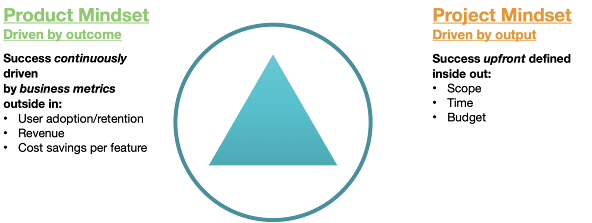
As you can notice, agile product owner certification in Bangalore focuses directly on products; thus, you have a Product owner. In traditional project management, the success of the project gets measured against scope, time and cost. Thus, the process leads to lesser value management and focuses on task management.

In contrast, the product mindset gets derived from the outcome, and the project mindset is activity. In traditional management, all three variables get managed by the project manager.

In a product environment, all the variables receive collaborative management.

For example, the scope and time get handled by the Scrum team, while the cost is by the product owner. In such cases, the confusion lies in the manager’s role.

Role Mapping

Direct one-to-one mapping is the way out for most of the executives of the organisations. We are following the Agile transformation. Thus, all these people will get a role in Scrum, and the rest of the group will get another position in Scrum. Among all these, I encounter a common idealogy in one-to-one mapping: taking the project management office and turning them into scrum masters and taking the business analysts to enrol them in product ownership roles. But, as per my point of view, it is not a great solution.

Is there a superior approach?

A “try scrum” entity identifies how to determine and focus on the individual strengths of each employee. It is very crucial while undergoing an Agile transformation. If you know who will fit best for each of the roles, acquiring success gets easier. Also, considering the individual’s passion helps in redefining the new responsibilities.

Now, let me get back to the original doubt.

Where is the role of Managers in Scrum? Do we need them?

There is no direct answer to this. My answer to this question will be; it depends on the organisation. Considering my experience, managers can play enablers. Although there is no buzz about Management in Scrum, managemental aspects are present in Scrum.

According to the Scrum Guide, Scrum looks after the existing effectiveness of the management, environment, and functioning ability to improve them. In other words, it challenges the way that the Organisation works to create value.

Scrum is not a methodology. It deliberates gives the choice-making to the management. It allows the business to get structured rightly and organise itself to get better. Considering from my viewpoint, managers are certainly enablers and can perform varied responsibilities.

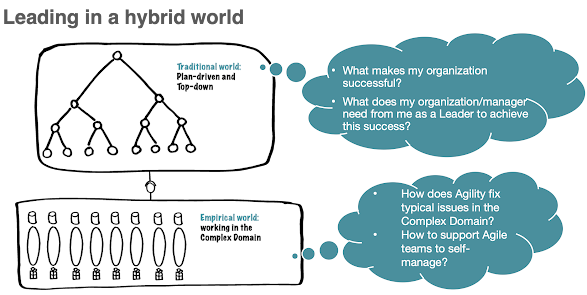
Leading in a Hybrid World

Every middle manager may not be suitable for the role of product owner or scrum master role. It leaves the scopes of uncertainties. But you need not worry. Despite having no role as a Scrum manager, it does not imply requiring them. Instead, it signifies that their role and responsibilities vary.


We primarily work in an environment that got created on traditional, plan-driven, and top-down principles. We are gradually transforming towards a self-organised and empirical environment. It gets designed for the complex domain. Leading an Agile team refers to making the people more successful with dynamicity. It is one of the major responsibilities of a manager. Among the many responsibilities of a manager, the following are a few significant ones:

·       Developing an environment for the growth of the Agile team

·       Work towards and organisation and scrum teams as a serving leader

·       Reconstruct the obstacles that hamper the growth

·       Proactively work on continuous improvement, self-improvement, feedback, adaptability.

·       Helping the team to succeed.

Conclusion

To conclude, Scrum does not have a role of a “manager”. It certainly does not imply we do not necessitate one. Ultimately, capitalising on individual strengths for transforming them to accomplish the new roles helps the organisation and individuals equally and leads to success.

Resource: https://www.tryscrum.com/blogs/what-is-managers-role-in-scrum/